Neutralizing the Extreme Elements of American Politics
The two extremes are controlling the narratives with aggression and high visibility. It does not have to be that way. Common Sense can Prevail if we stop coddling extremism
Why America May Need Three Political Parties Instead of Two
By Joe Wallace
Nearly two years ago I wrote about an idea that seemed more theoretical than practical. Since then, political polarization has continued to intensify, and I believe the central premise deserves another look.
The problem facing America is not simply that we have two political parties. It is that each of our two major parties contains an ideological wing whose influence often exceeds its numbers. The loudest voices frequently define the public image of the entire party, while millions of moderates find themselves politically homeless.
What if our political system better reflected the way Americans actually think?
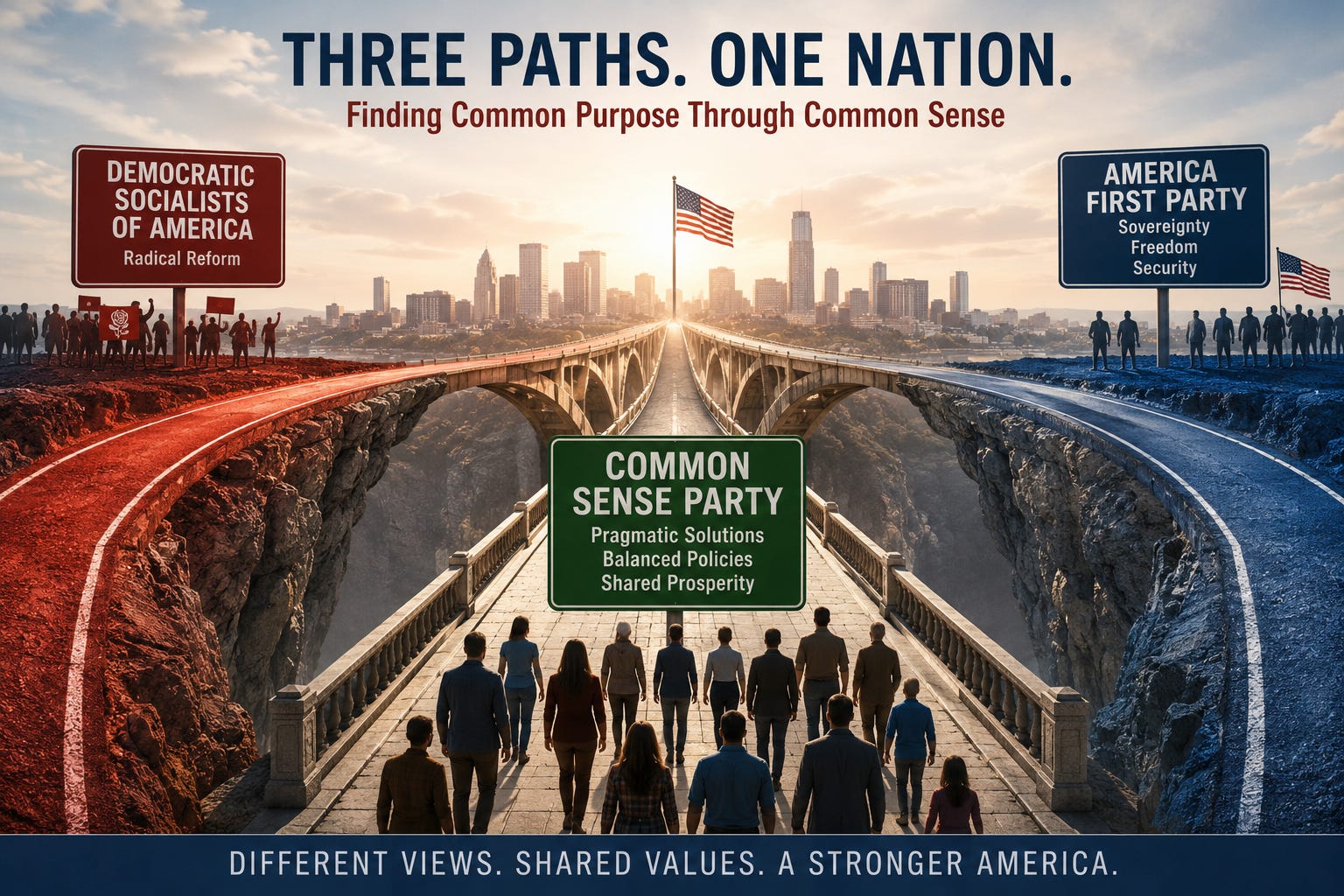
Imagine a three-party system consisting of the Democratic Socialists of America, an America First Party, and a broad Common Sense Party representing the millions of Americans who believe in practical problem-solving rather than ideological purity.
This is not an argument against either ideological movement. Every viewpoint deserves representation. It is an argument that no ideological minority should be mistaken for a governing majority.
The Democratic Socialists of America
The Democratic Socialists of America advocate a vision that extends well beyond traditional progressive politics. Their long-term platform includes replacing the Electoral College with a national popular vote, expanding proportional representation, and reducing the power of judicial review by the Supreme Court. Recent reports on updates to their governing program describe proposals that would go much further, including abolishing the United States Senate, replacing the independently elected President and Supreme Court with institutions chosen by and subordinate to Congress, and drafting a new constitution creating a democratic socialist republic. Readers can evaluate these proposals for themselves.
Many Americans support some of the DSA’s economic or social policies while rejecting others. The point is not whether these ideas are good or bad. The point is that they represent one distinct philosophy of government that deserves to stand on its own rather than being assumed to represent every voter who identifies as a Democrat.
The America First Party
At the opposite end of the spectrum would be an America First Party.
Its supporters generally emphasize limited federal government, stronger border security, national sovereignty, skepticism of international institutions, and a belief that American interests should take precedence in foreign and economic policy.
Like the Democratic Socialists of America, this movement contains passionate supporters who deserve representation. It also contains ideas that many Americans embrace and others reject.
Again, the issue is not whether these policies are right or wrong.
The issue is that this philosophy should stand on its own rather than being viewed as synonymous with every Republican voter.
The Common Sense Party
Between these two movements lies what I believe is America’s largest political constituency.
These are citizens who may disagree with one another on taxes, immigration, healthcare, regulation, or social issues, yet share several important characteristics.
They believe compromise is not surrender.
They prefer practical solutions over ideological victories.
They value constitutional checks and balances.
They believe good government should solve problems rather than constantly create new political battles.
This group includes moderates, independents, center-left Democrats, center-right Republicans, libertarians who recognize the need for functioning government, and countless Americans who simply want elected officials to govern responsibly.
Whether they constitute a majority or not is ultimately for voters to decide. What seems clear is that neither ideological extreme comes close to representing the entire American electorate.
Why the Current System Rewards Extremes
The current political structure often amplifies the influence of highly motivated activists.
Low-turnout primaries, safe congressional districts, partisan fundraising, and social media all reward candidates who energize their political base rather than those who build broad coalitions.
The result is that elected officials often spend more time avoiding primary challenges than persuading the political center.
That is not a criticism of either party.
It is a criticism of incentives.
A Lesson From Engineering
As an engineer, I spent much of my career designing systems intended to remain stable under changing conditions.
Every well-designed control system includes stability margins because engineers assume disturbances will occur.
Democracies are no different.
Political disagreements are inevitable.
The challenge is designing institutions that encourage those disagreements to produce better solutions instead of greater instability.
Good political systems should reward collaboration more often than confrontation, and compromise more often than ideological purity.
A Better Future
America does not need less debate.
It needs better incentives.
A political system that allows the Democratic Socialists of America to advocate openly for democratic socialism, allows an America First Party to advocate openly for its vision of conservatism, and allows a Common Sense Party to govern from the broad middle would more accurately reflect the diversity of American opinion.
Perhaps the greatest strength of such a system would not be that everyone agrees.
It would be that every viewpoint is represented honestly, and no ideological minority is mistaken for the voice of an entire political party.
The future of our republic will not be determined by how loudly our extremes speak.
It will be determined by whether the political center finds its voice.